What’s the difference between Zepbound and Ozempic?
These two GLP-1s are often mentioned in the same breath. Here’s how the medications differ, including how they work, how well they work, and what they could cost.
)
If you’re curious about GLP-1s, you may have wondered about both Zepbound and Ozempic, two of the most name-dropped medications in the category. But while both drugs may pop up in casual conversation about weight loss, they aren’t interchangeable. In fact, Zepbound and Ozempic are actually FDA approved for different uses: Zepbound for weight loss and Ozempic for type 2 diabetes management.
To truly appreciate why this distinction matters, we’re digging into their makeup, approvals, uses, and more. Read on for a clear side-by-side on the differences between Zepbound and Ozempic to help you compare GLP-1 options and learn which (if any) may make sense for you and your health.
Key takeaways
Zepbound and Ozempic are different medications: Zepbound is tirzepatide (a dual GLP-1/GIP) FDA approved for weight loss. Ozempic is semaglutide (a GLP-1) FDA approved for type 2 diabetes.
If your goal is weight loss, the true head-to-head is Zepbound vs. Wegovy (the latter being the brand name for semaglutide that is approved for weight loss). Ozempic isn’t FDA approved for weight loss. It’s approved for the management of type 2 diabetes.
In clinical trials, the active ingredient tirzepatide has produced greater average weight loss than semaglutide, but individual results and tolerability vary.
Both Zepbound and Ozempic come in once-weekly injections with similar gastrointestinal (GI) side effects and the same class thyroid-tumor boxed warning. Ozempic also comes in pill form.
The key difference: different drugs, different approvals
Ozempic and Zepbound are different medications. Ozempic is the brand name for the active ingredient semaglutide, a GLP-1 receptor agonist that works by mimicking the natural gut hormone in your body. It’s FDA approved for people with type 2 diabetes to lower blood sugar, reduce the risk of major cardiovascular events in people who also have cardiovascular disease, and lower the risk of worsening kidney problems in those who also have chronic kidney disease.
Zepbound is a brand name for the active ingredient tirzepatide, which works on receptors for two gut hormones: GLP-1 and GIP. It’s FDA approved for chronic weight management in adults with obesity, or adults with overweight and at least one weight-related medical problem. In 2024, it also gained approval for treatment of moderate to severe obstructive sleep apnea in adults with obesity.
If you’re looking for diabetes management, then you’d actually want to compare Ozempic and Mounjaro, since Mounjaro is the brand name for tirzepatide that’s approved for type 2 diabetes. If you’re interested in weight loss, a more appropriate comparison would actually be Zepbound and Wegovy. Wegovy is another brand name for semaglutide, the same active ingredient as Ozempic. Unlike Ozempic, it is approved for weight loss.
How they work
“GLP-1 drugs work on both gut and brain,” says Dr. Melissa Shoemaker, M.D., an assistant professor in the department of internal medicine at UT Southwestern Medical Center who specializes in obesity medicine. That’s true for both Zepbound and Ozempic.
In your gut, the medications slow down gastric emptying, or how quickly food moves out of the stomach, says Shoemaker. “That’s probably what most people notice first — that you could eat a smaller portion and still feel satisfied,” she says. Meanwhile, both drugs have effects on your brain. Right after you eat, gut hormones send signals to your brain to say that you’re full and satisfied. “They’re working on a part of the brain that’s in charge of hunger, satiety, and cravings,” she says. This is why GLP-1s quiet food noise, a.k.a. the intrusive chatter in your mind about food. They can also help regulate insulin and blood sugar, which is why they’re beneficial to people managing diabetes.
Weight-loss results
Even though Zepbound is approved for weight loss and Ozempic is approved for type 2 diabetes management, both Zepbound and Ozempic can lead to weight loss.
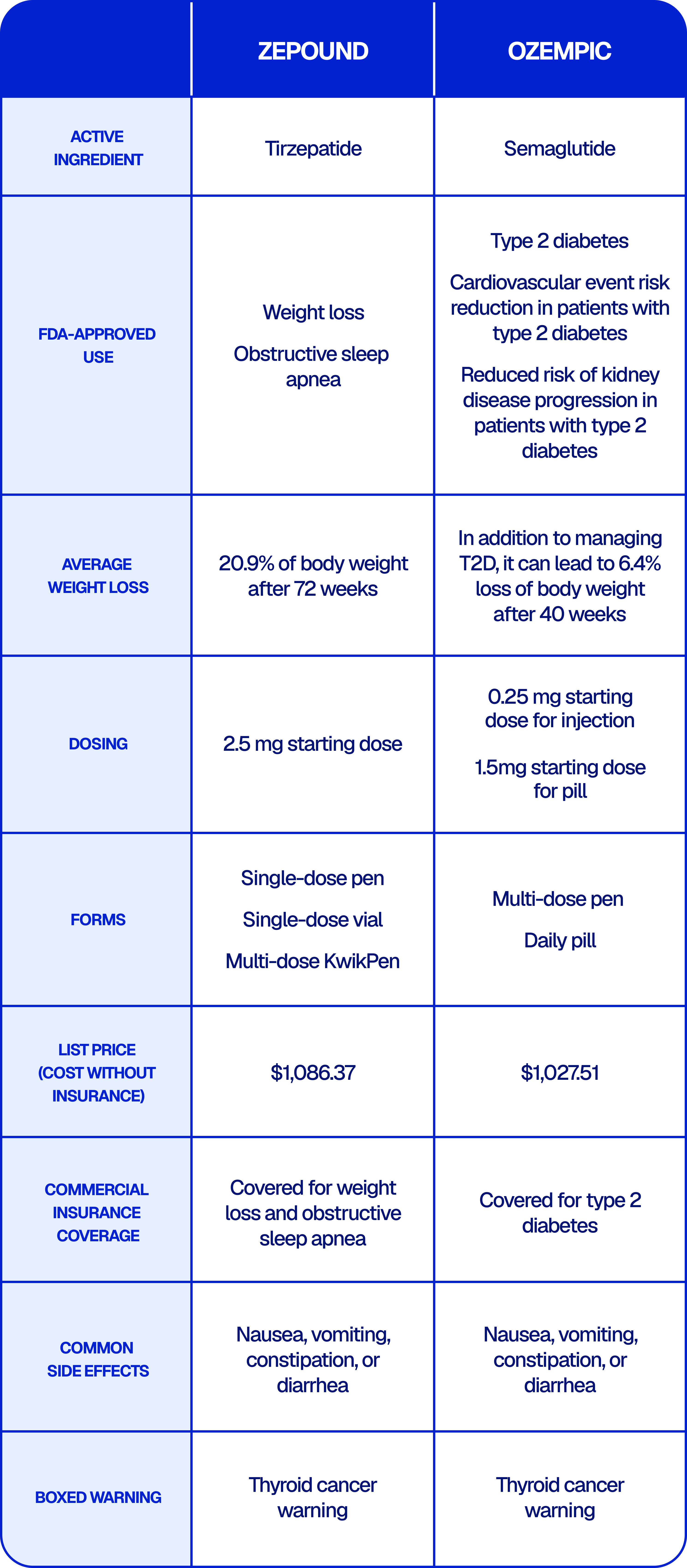
According to a 2022 study in the New England Journal of Medicine of over 2,500 people, eligible patients who received a once-weekly 15 mg dose of tirzepatide (Zepbound) lost an average of 20.9% of their body weight over the 72-week period when combined with diet and exercise. For Ozempic, a 2021 study published in The Lancet Diabetes & Endocrinology found that eligible patients who took 2 mg of semaglutide (Ozempic) once a week lost an average of 6.4% of their body weight when paired with diet and exercise after 40 weeks.
More recently, a 2025 study published in the New England Journal of Medicine put tirzepatide and semaglutide head-to-head. It found that eligible patients who received the maximum tolerated dose of tirzepatide (10 or 15 mg) lost an average of 20.2% of their body weight after 72 weeks; those on the maximum tolerated dose of semaglutide (1.7 or 2.4 mg) lost an average of 13.7%.
Keep in mind, though, that studies report averages — and like with all meds, individual results may vary. “Average weight loss means that some people are going to lose less and some people are going to lose more,” says Shoemaker. “But overall, generally people lose a little bit more with the Zepbound.”
Zepbound and Ozempic at a glance
Side effects and safety
Common side effects of Zepbound and Ozempic tend to span the GI realm — nausea, constipation, diarrhea, and vomiting, for instance — though folks tend to be “relatively comfortable” on the meds, according to Dr. Zoya Mohiuddin, M.D., the head of patient safety at Weight Watchers.
The side effects are generally similar between Zepbound and Ozempic, though some people may experience less nausea on Zepbound due to how it targets the GIP receptor along with the GLP-1, says Shoemaker.
It’s important to recognize too that even if you experience side effects when you start your medication, it doesn’t mean that you always will. “As you continue, you actually develop tolerance, and your side effects usually get better over time,” says Mohiuddin.
Regarding safety, both contain the same class boxed warning regarding medullary cancer of the thyroid. “The studies show that this has been observed in mice, but they didn't necessarily observe this in humans,” says Mohiuddin. “The warning is to be extra safe” for people who are at higher risk. Before starting either drug, you’ll talk with your clinician to determine if you have any contraindications.
Cost and insurance
When determining which medication to choose, insurance coverage is “a pretty big practical reality for most people” that helps dictate it, according to Shoemaker.
Without insurance, the list price of both Zepbound and Ozempic are pricey, hitting the four figure range per month. According to NovoCare, the list price for Ozempic is $1,027.51. As for Zepbound, the cost can hit up to $1,086.37 per month, per Lilly.
If your insurance plan covers it, your actual cost can be much cheaper. Remember, though, that the chances of coverage depend on your specific plan and whether or not you have any conditions the drugs are FDA-approved for (like type 2 diabetes for Ozempic or obesity for Zepbound.)
“People should be empowered to call their insurance, but instead of saying, ‘Is this covered?’ They should also ask, "Okay, is it covered for weight loss? Are there very specific BMI requirements or any other requirements?’” says Shoemaker. Talk with your clinician to help you navigate the process.
Zepbound and Ozempic also offer savings programs and self-pay options that can knock the price down as well. Weight Watchers’ Med+ program can help you navigate your insurance coverage to ensure the best rate for the medications, because your Care Team includes an insurance coordinator who can maximize your coverage.
Which is right for you?
If you’re looking for weight loss specifically, the better comparison to consider would be Zepbound and Wegovy instead of Zepbound and Ozempic. That’s because, as we mentioned, Wegovy is the form of semaglutide that’s approved for weight management; Ozempic is approved for diabetes, though it also often leads to some weight loss.
The right GLP-1 for you depends on your goals, health profile, insurance coverage for GLP-1s, and clinician guidance. Tolerability also matters, too: You may experience more or less side effects on one medication versus another.
Working with a Weight Watchers clinician can ensure you pick the right medication for your body and your goals. No matter which medication you choose, you may have better results through the Med+ program. After two years, Med+ members prescribed a GLP-1 medication who engaged regularly with the Weight Watchers app lost 19% more weight, on average, than those who didn’t.* That’s because Weight Watchers offers wraparound support beyond the medication — including helping you manage any side effects, making sure your nutrition and hydration are on point, helping you get in a good exercise routine, and making you feel included in a community of people on the same journey.
The bottom line
While both Zepbound and Ozempic are talked about often in the weight loss realm, they’re actually two different drugs with different approvals — of the two, only Zepbound is approved specifically for weight management.
If you’re looking solely at the numbers, tirzepatide (the active ingredient in Zepbound) has the weight-loss edge over semaglutide (the active ingredient in Ozempic and Wegovy). But it’s not just about the numbers: Choosing the right weight-loss medication for you depends on other things, too, like tolerability, other health conditions, and insurance coverage (along with final cost). Your clinician will help guide your final decision, which should take all of these factors into account to determine the best option for you.